


Someone who gave to your nonprofit last year may still care deeply about your work, even if you have not received another gift. Perhaps they usually give in December. Perhaps an email went to an old address. Or perhaps they have not heard what their support helped accomplish.
With November here, now is the time to find those supporters and reconnect. Review donor records and begin personal outreach before GivingTuesday on December 1, 2026, then carry those conversations into your December appeals. Start this week with a group your team can realistically follow up with.
Winning back lapsed donors starts with understanding who has stopped giving, who may simply be waiting for their usual giving season, and what would make your next message meaningful to them.
What Counts as a Lapsed Donor Before Year End
A lapsed donor is someone who has not given again within your nonprofit’s expected giving cycle. For an annual donor, that might mean more than 12 months since their last gift. For a monthly donor, a missed payment deserves attention much sooner.
A donor who gave last December but has not given yet this year belongs on your outreach list, but may not be overdue. Check their giving history before assuming that you have lost the relationship. A timely program update can help maintain that connection without making the donor feel that they have missed an obligation.
 What Current Donor Retention Benchmarks Tell Us
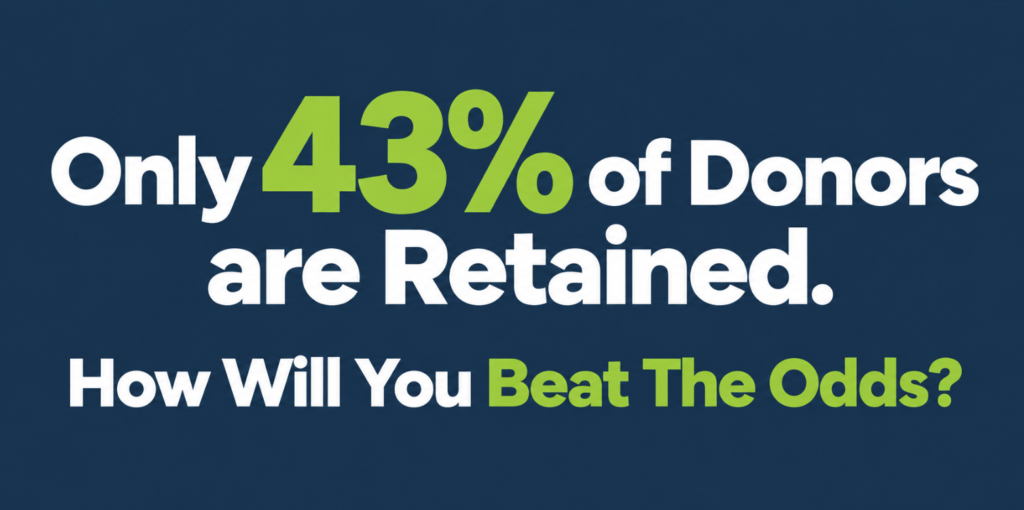
The Fundraising Effectiveness Project 2025 Report found that overall donor retention was 43.3%, compared with 43.1% in 2024. Donor numbers fell an estimated 3.6%, even as total giving increased. These findings are a reminder to look beyond dollars raised when evaluating the health of your donor relationships.
The latest available update, covering the first half of 2026, reported 26.4% retention through Q2 and found that only 11.3% of donors acquired in 2025 had given again by the end of June. Those are partial-year figures, not full-year retention rates.
Use benchmarks as context, then compare your own results over matching periods. Compare your retention rate through October 31 with the same point last year, rather than with a completed calendar year.
Donor retention rate = Donors from the previous year who gave again during the measured period ÷ Total donors in the previous year × 100.
For example, if 120 of last year’s 300 donors have given again by October 31, your year-to-date retention rate is 40%. New donors acquired this year do not belong in that numerator. Your final annual rate will depend on how many additional donors return before year end.
Build LYBUNT PYBUNT and SYBUNT Segments You Can Use

PYBUNT usage varies, and SYBUNT can overlap with the other groups. Document your definitions and exclusions so each donor receives the intended message once.
Giving dates are only part of the picture. Within each group, identify former repeat donors, first-time donors who never made a second gift, volunteers, event participants, and supporters with a staff or board connection. A longtime volunteer who stopped donating may need a very different conversation from someone who made one gift several years ago.
Use This Lapsed Donor Checklist Before Sending Appeals
Work through this checklist before preparing your first message:
- Bring gifts up to date. Enter recent checks and online gifts, and review donor-advised fund and other gifts that may need to be linked to the supporter’s record.
- Check for duplicate records. Make sure a donor’s recent gift is not sitting under a second contact record.
- Verify contact details and preferences. Review email and mailing addresses, deceased records, and do-not-contact instructions.
- Set your reporting dates. Record the giving periods used for each segment and the date the list was created.
- Review the donor’s history. Look at gift timing, frequency, program interests, and other involvement before deciding how to reach out.
- Choose a useful update. Match the message to the program or outcome the donor previously supported.
- Assign personal follow-up. Give priority calls and notes to someone who knows the donor whenever possible.
- Test the next step. Check donation links, mobile forms, reply addresses, and phone numbers.
- Coordinate your campaign calendar. Plan re-engagement alongside GivingTuesday and year-end appeals so donors do not receive conflicting messages.
- Refresh lists before every send. Move donors who have returned into thank-you and stewardship communications.
For more database preparation, read Data IS Donations: Make Sure Every Donor Gets Your Year-End Ask.

Find Out Why Donors Stopped Giving
A report can identify a gap in giving. It cannot explain the donor’s reason for that gap.
Financial circumstances may have changed. A donor may be interested in a different program, feel disconnected from your organization, or believe their earlier gift completed the project they wanted to support. A failed recurring payment or an outdated address can also interrupt giving.
Review your side of the relationship. Did the donor receive a timely thank-you? Have you shared results since their gift? Did a staff transition leave their questions unanswered?
When appropriate, ask a simple question: “What would you most like to hear about from us?” Record the response and use it to guide future contact. If a donor asks for fewer messages or says they cannot give right now, respect that preference.
Plan Your November Outreach Before GivingTuesday
Start this week. Update gift records, run your reports, and choose the donors who need personal attention. Ask staff or board members with existing relationships to help with calls.
Use early November to reconnect. Send a relevant program update or personal note, then follow up with donors who reply. Prepare a second group as your team has capacity.
Refresh your lists before December 1. Remove supporters who have already given from reactivation messages and coordinate the remaining outreach with your GivingTuesday campaign. Continue appropriate conversations through December, using the donor’s response to guide the next contact.

Reconnect With Sample Email Letter and Phone Outreach
Adapt these examples to the donor’s history. Replace bracketed details with accurate information and use a real result your nonprofit can substantiate.
Sample Email for a LYBUNT Donor
Subject: An update on the work you helped support
Hi [First Name],
Your support of [Program] last year helped [Specific Outcome]. I wanted you to know that [Brief Current Update], and to thank you again for helping make this work possible.
As we prepare for the months ahead, we are focused on [Current Need]. Is [Program] still the part of our work you are most interested in? You can reply directly to this email. I would welcome the chance to hear from you.
If you would like to support the next step, you can make a gift here: [Donation Link]. Thank you for being part of [Organization].
[Name and Title]
Sample Letter for a Donor Who Has Been Away Longer
Dear [Preferred Salutation],
When you supported [Program or Campaign], you helped [Specific Outcome]. We remain grateful for that support, and I wanted to share what has happened since then.
[Two or three sentences explaining a meaningful program development and the people or community it serves.]
This year, we are working toward [Specific Goal]. If this work continues to reflect what matters to you, would you consider a gift of [Appropriate Amount] or an amount that feels right for you? Your contribution would help [Accurate Description of What Gifts Support].
You can give at [Short Donation URL] or use the enclosed reply form. If you would prefer to talk first, please contact me at [Phone or Email]. I would appreciate the chance to reconnect and answer your questions.
Thank you for the difference you have already helped make.
[Name and Title]
Sample Phone Conversation to Reopen the Relationship
“Hi [First Name], this is [Name] from [Organization]. Is this a good time for a brief conversation? I’m calling to thank you for your past support of [Program] and share a quick update: [One-Sentence Result]. How have you been, and is this work still an interest of yours?”
Pause and listen. If the donor is interested, ask permission to send an update or discuss the current need. If they raise a concern, acknowledge it and agree on a next step. Record any follow-up promise so someone on your team completes it.
Personalize Lapsed Donor Appeals With Eleo
Eleo Donor Management Software brings donor information and fundraising activity together so your team can prepare outreach with more context. Use these steps to turn your donor records into a practical re-engagement plan.
- Start with the right report. In Eleo, go to Reports > Donor Retention Reports > LYBUNT/SYBUNT Report. Set the donation period and the no-donation period for the group you want to identify. For LYBUNT outreach, use last calendar year and the current calendar year. The report also supports custom date selections and filters such as campaign, fund, and appeal. [Source 3]
- Build manageable donor segments. Use Eleo’s donor list building tools to organize outreach around giving history and involvement. Apply exclusions deliberately when creating separate PYBUNT and older SYBUNT groups.
- Review the relationship before writing. Check the contact record for previous gifts, communication preferences, interactions, and relevant interests. Use those details to choose a program update and a suitable request. If someone has consistently supported your food pantry, lead with that work.
- Prepare personalized donor communications. Use Eleo’s mailing tools and templates for letters and emails, with supported email integrations where appropriate. Check salutations and gift references before sending. [Source 4]
- Assign and record follow-up. Use donor follow-up tasks to schedule calls and notes. Record responses so the next person who contacts the donor knows what was discussed. [Source 5]
- Before each appeal, update gift records and rerun your report or refresh the relevant list. A supporter who just returned should receive a thank-you rather than another message asking them to come back.
Measure Who Returns and Keep the Relationship Going
Track how many donors in each outreach group give again, the dollars they contribute, and the conversations or contact updates your campaign generates. To measure campaign reactivation, divide the number of donors in your targeted lapsed group who return during the campaign by the total donors in that group, then multiply by 100.
Keep this measure separate from annual retention. A donor returning after several years is a reactivated donor, but would not count as retained from last year if they did not give last year.
Thank returning donors promptly and follow through with updates about the work they supported. Your first returning gift is an opportunity to rebuild an ongoing relationship.
As you prepare your GivingTuesday campaign, make reconnection part of the plan. Eleo’s fundraising reports and analytics can help your team identify supporters who need attention and evaluate the results of your outreach.
Schedule a personalized Eleo demo to see how donor records, reporting, communications, and follow-up tools can support your year-end fundraising.


